
Published 11 Apr 2026
The Clay Conundrum: Ambiguity of Food Safety in Studio Ceramics
Ceramics inhabit a curious space in contemporary material culture. They're grounded in ancient artisanship and tradition but are subjected to modern industrial scrutiny. In an age when invisible hazards are in our air, water, and food, scientific standardization is necessary to determine the quality of ceramics and separate decorative from food-safe wares. But despite scientific uncertainty, many still put complete faith in homemade ceramic bowls.

Introduction
A handmade ceramic bowl is considered, for all intents and purposes, natural because it comes from clay that is shaped by hand and fired in flame. Most assume that alone makes it safe to eat from. But is that always true?
This article breaks down what "food safe" really means when it comes to ceramics. It also explains how glazes work, what can leach into your food, how different countries regulate pottery, and why studio made pieces sit in the grey area between craft tradition and scientific testing. If you care about what touches your food, the following will help you understand what to look for — and what questions to ask.
The Chemistry Behind Ceramic Foodware
Before we get into the ambiguity of food safety surrounding ceramic bowls, let's consider the chemistry. Put simply, there are three conditions that determine the food safety of ceramic wares:
- Vitrification — How fully the clay body has melted and densified during firing.
- Glaze stability — Whether the glaze resists leaching (release of metals) when in contact with food or drink.
- Surface integrity — The presence of cracks, crazing, pinholes, or uneven glaze application.
Vitrification and surface integrity are easy to measure. But glaze stability, especially trace element migration, is not so easily determined. Under acidic conditions, the glossy surface of a pottery bowl can still leach toxic metals. On the other hand, a matte glaze may appear stable but can fail durability tests.
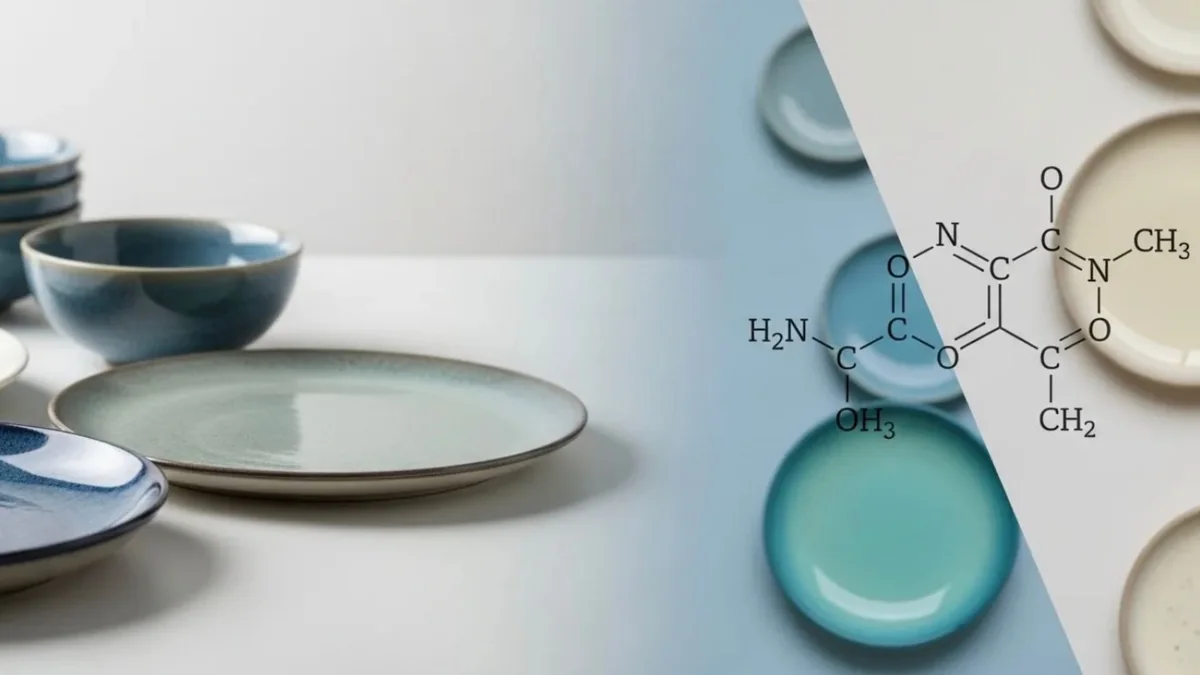
Lead and cadmium found in glazes are not the only elements that are released. Cobalt, copper, and manganese also migrate in trace quantities. This happens at such a small scale that they are detectable only in laboratory testing using analytical tools such as ICP-OES (Inductively Coupled Plasma Optical Emission Spectrometry).
In studio practice, especially when materials are mixed ad hoc and kilns are variably loaded, the chemical composition of a fired glaze can differ significantly from batch to batch. Community platforms such as Glazy caution that no glaze recipe can be guaranteed food-safe across all materials, kilns, and firing conditions without laboratory testing. Without proper control of variables, even widely trusted formulations can behave unpredictably.
Regulatory Frameworks: Industrial Precision vs. Studio Ambiguity
Regulatory bodies around the world define "food safe" for ceramic tableware slightly differently based on their laboratory testing standards. The following regulatory approaches highlight how the definitions can both overlap and contradict.
United States — Food & Drug Administration (FDA)
- The FDA issues Compliance Policy Guides (CPGs) setting action levels for lead and cadmium migration from ceramic ware. Testing involves exposing surfaces to acidic solutions and measuring metal migration. Labelling as "lead-free" is also strictly regulated.
European Union — Directive 84/500/EEC
- The EU regulates lead and cadmium migration limits from ceramics for food contact. Manufacturers and importers must demonstrate compliance via laboratory testing before entering the market. Enforcement is systematic, especially for imports.
Canada — Glazed Ceramics & Glassware Regulations
- Canada establishes defined migration limits categorised by product type. Non-compliant items must be permanently marked "Not for Food Use," bridging the ambiguity between decorative and functional ware.
India — Bureau of Indian Standards (BIS)
- BIS publishes standards IS 10125 and IS 1478 covering lead and cadmium release limits. Enforcement in smaller studio settings remains minimal. Many studio potters rely on tradition and community wisdom rather than measurable compliance frameworks.
Industry Practices vs. Studio Realities
Given the regulatory frameworks, one may assume that all ceramic manufacturers and studios would standardise glaze formulation and test migration routinely. But that is far from the case in studio contexts.
Industrial Manufacturing
- Glaze formulation is standardised
- Firing curves are controlled and documented
- Migration testing is routine
- Quality assurance systems are institutionalised
- Simultaneous FDA and EU compliance
Studio Practice
- Clay bodies mixed in small batches
- Glaze recipes frequently adapted
- Kiln firings vary from load to load
- Formal leach testing is rare
- Reliance on experiential knowledge
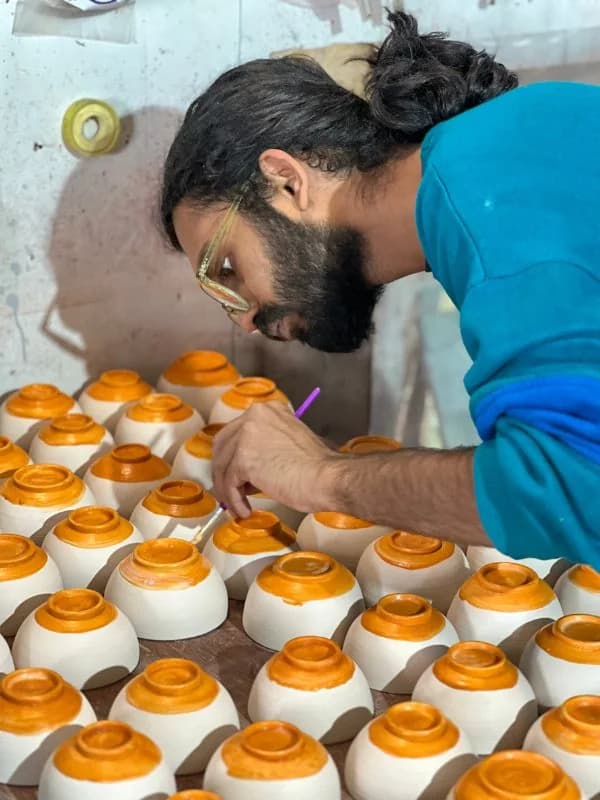
Some makers trust glaze packaging labelled "food safe." Others note that even lead-free glazes can behave unpredictably, especially if fired in kilns previously used for lead-bearing glazes. The ambiguity does not necessarily imply danger — it only highlights an absence of standardised testing and documented quality assurance systems.
Beyond Lead and Cadmium: The Hidden Variables
Glaze surfaces can deteriorate due to acidic foods such as tomato or citrus, repeated dishwasher cycles, and mechanical abrasion over time. Most regulatory frameworks focus on lead and cadmium because their health impacts are well documented:
- Lead affects neurological development, cognitive function, and multiple biological systems even at low exposure levels.
- Cadmium exposure is associated with kidney damage and skeletal weakening.
However, research indicates that other elements — including aluminium, copper, manganese, and vanadium — can also migrate depending on glaze formulation, pH of the contacting substance, temperature, and duration of contact. Many of these elements fall outside traditional regulatory limits, revealing the limitations of current frameworks in addressing the full complexity of ceramic–food interactions.
Why the Ambiguity Matters: Health, Culture, and Trust
If you see an industrial ceramic mug certified under FDA or EU standards, you can be sure it has undergone the necessary laboratory testing. But a handmade unlabelled mug from a studio may be equally safe. Without documentation, there is no objective way to verify it — but that alone is no reason to conclude it is unsafe.
“Consumers continue to place their faith in makers while makers place their faith in experience that has been evidence enough of quality over generations. Neither position is irrational. Yet neither substitutes for systematic verification.”
In India, where traditional pottery practices coexist alongside modern manufacturing, this ambiguity becomes even more pronounced. In many regions, pottery is embedded in generational knowledge systems rather than modern laboratory systems. Safety has historically been determined through continuity of use, not chemical assay. The shift toward regulatory verification is therefore not only scientific but cultural.
Clay, Crisis, and the Comfort Paradox
The movement towards scientific scrutiny for ceramic wares is not without a tinge of irony. We inhabit an era of pervasive, often invisible hazards — microplastics in our water, particulate matter in our air, chemical residues in packaged foods, endocrine disruptors in consumer goods. Meanwhile, we scrutinise ceramics.
We celebrate the fractured texture and glaze variation of ceramics, and still ask whether it is safe to eat from a handmade bowl. These double-standards hint at a deeper reality: we are not so much afraid of clay as we are uncomfortable with uncertainty.
Ceramic wares are honest. How they were made and transformed is etched into their surface and glaze. They do not conceal their process. The question is not whether handmade ceramics are safe or unsafe in absolute terms. The real question is: how much uncertainty are we willing to accept, and who bears responsibility for managing it?
For studio potters, best practices include:
- Use commercially tested, lead-free glaze systems
- Avoid firing ware in kilns previously used for lead glazes
- Maintain firing logs and consistent schedules
- Clearly label decorative ware as non-food-safe
- Consider periodic third-party leach testing for production lines
Food safety in ceramics is not a fixed binary state. It is a continuum shaped by material science, regulation, maker responsibility, and cultural trust.
Bibliography & Further Reading
- Bureau of Indian Standards. (1992). IS 1478 Clay Flooring Tiles — Specifications. law.resource.org
- Bureau of Indian Standards. (1982). IS 10125 Specification For Copper Carbonate. archive.org
- Demont, M. et al. (2012). Migration of 18 trace elements from ceramic food contact material. Food and Chemical Toxicology. sciencedirect.com
- Official Journal of the European Communities. (1984). Council Directive 84/500/EEC. eur-lex.europa.eu
- Food and Drug Administration. (2010). Guidance for Industry: Safety of Imported Traditional Pottery Intended for Use with Food. fda.gov
- Glazy. (n.d.). Glaze Safety with Health Warning. help.glazy.org
- Government of Canada. (n.d.). Industry Guide to the Glazed Ceramics and Glassware Regulations. canada.ca
- Hansen, Tony. (2021). Digitalfire Insight Reference Library & INSIGHT Manual. digitalfire.com
Written by
Dhiram Patel